
Standard 7
The teacher plans instruction that supports every student in meeting rigorous learning goals by drawing upon knowledge of content areas, curriculum, cross-disciplinary skills, and pedagogy, as well as knowledge of learners and the community context.
This standard focuses on the necessity of the production of quality lesson plans. The teacher should exhibit how detailed and intentional planning - taking into account not only the content but also the classroom environment and participants - leads to a timely meeting of goals or benchmarks.
The evidence below exemplifies how I have been able to plan and implement many different lessons that take into account the context of my learners, as well as the content areas and curriculum expected for the grade level.
 This is a student's work created during a lesson I created to link the upcoming Halloween Day to the Social Studies concept of maps |
|---|
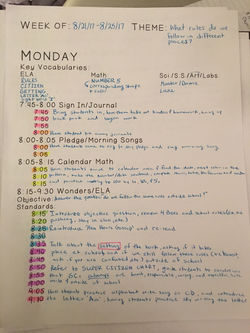 This is an example of a minute by minute plan I created in order scaffold my lesson planning in order to help my timing during instruction |
 This is a model of what I would expect to see during a nature walk that connects the science concept of observation, the engaging experience with nature and the literary concept of haiku poetry |
 This is an exemplar for the previous observation page on nature haiku. After revising and editing, this is the level of product what I would expect students to be able to create |
 This is a model of the beginning stages of planning a bio-poem for a fourth grade student |
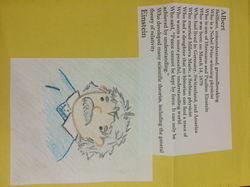 This is the exemplar sample of what I would expect to see as a final product for the bio-poem after editing and revising. |
Reflection
The term 'rigorous' does not mean that your students have to be pushed to their limits during every lesson. Instead, I take it to mean that you as the teacher should be extremely thorough in your planning to create experiences for your students that create new understandings everyday that are with you, whether it be on completely new concepts or building off of past schema to finally get how to solve a certain problem.
Ensuring that your students are able to understand what is being taught and reach their full potential is the goal of many teachers. In an sense, it is tailoring the aforementioned rigor to the extent each student can feel comfortable at. For example, some students may be able to apply a concept to more complex situations, while others are comfortable with more concrete applications.
I have been given many opportunities to plan and instruct lessons that allow students to stretch beyond what they thought they could do and reach goals that they initially thought were to high for them. For example, when we made the trick-or-treating map, the students all told me 'I don't know how to make a map!' and 'That's hard', however once I modeled what the map should look like and they began to envision their trick or treating plans, they were able to make creative maps that included everything I asked of them (a path to each house and Xs to mark which houses they plan on going to. They had such a great time making the maps that by the end of the lesson they wanted more time to make their maps even more detailed!
Additional Artifacts
The lesson above was created for a kindergarten class in which I taught a group of 3-4 students depending on absences. In this lessons I expected students to be able to use the literary skill of narrowing to select one topic out of several to write about, and the to use the skill of expanding to come up with four reasons why the like that topic. For this example, the rigor comes from my expectation of my students to use more than one literary skill in a single sitting with me, as they were used to dealing with one per day. One thing I learned from the implementation of this lesson was that when introducing more difficult concepts or skills into your lesson, remember to increase the scaffolding, as well.
The plans above detail the instruction for one preschool student in particular that I was working with alongside periodic whole group instruction. This students, while academically more advanced than the majority of his peers, behaviorally he was easily distracted and prone to distracting other students as well with his behaviors. In response to this I planned lessons that allowed for more active participation on the part of the student so that he would remain constantly engaged throughout the whole lesson. Through this experience I learned that once a student feels that they are understand and valued for who they are and what they can give, their behavior and performance within the whole group becomes more engaged and positive, as well.