
Standard 5
The teacher understands how to connect concepts and use differing perspectives to engage learners in critical thinking, creativity, and collaborative problem solving related to authentic local and global issues.
The focus of this standard is to ensure that teachers provide students with multiple perspectives and uses of content knowledge within a real world viewpoint as well as allow students to create their own solutions to these problems - theoretically or otherwise.
The evidence below tells of how I have been able to link global and local topics to core instruction so that my students are able to think critically about the world around them, and so I am ready to help them prepare for it.
 These sugar skulls were created with my kindergarten class when we learned about how other countries celebrate Halloween. We also learned about and created punkies from England, and Lanterns for the Dead from China and Japan. |
|---|
 While learning about the members of our community, we focused on farmers in my kindergarten class, discussed what they do, and even thought like farmers to protect our crops from the sun! |
 While learning about the community, we also focused on grocers and grocery store workers, as several of my students said that their parents work in grocery stores. |
 Linking Science to Social Studies, we also looked at what tools different community helpers use in their jobs. |
 Linking Science to Social Studies, we also looked at what tools different community helpers use in their jobs. |
 hjvmhcgmh |
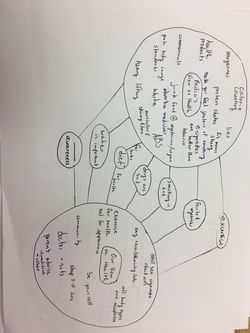 Here is a graphic organizer created with my 6th grade class comparing what the media tells us about healthy lifestyles and what we know to be true. |
Reflection
For myself, one of the most important things a teacher can do is to show their students how all of the subject areas intertwine in order to create the world around us. There is no part of our world that is solely math, solely science, or solely social studies. In addition, the fine arts are an important area for students to be allowed to explore, as just with learning styles, students may find that while they do not find passion in the numbers of math or science, they may thrive for the colors and strokes of painting, or the steps of a dance. Not only must we allow our students to discover themselves in such as way, but we must also show them that those other content areas are alive within their passions, as well.
Just as was stated in an earlier standard, including differences into your teaching is a part of teaching in a modern world that cannot be ignored. Just as student have different stories that create a multitude of personalities, so too, does history and current events hold multiple perspectives from different peoples. Allowing students to see that there is never only one side to any story promotes critical thinking about the world around them and bolsters a sense of empathy towards opposing sides in regards to their own viewpoints, as well.
Part of creating students who are self-directed, engaged learners is teaching students how to think critically, creatively, and collaboratively, as these all give students a glimpse into what problem solving looks like in real-world situations. Have students think about a problem critically and come up with creative solutions in collaboration with others gives students a feeling of empowerment that they can make a difference in the world around them.
Teaching students to look at current issues locally, nationally, and internationally gives students a sense of being citizens taking part in the world around them. So often students tell me that they don't feel connected to the rest of the world and that school doesn't help prepare them for the real world, and so I believe that allowing students to actively be a part of their communities allows them to see the applications of what they learned to the 'real world' around them.
I intend to continue learning and discovering new points of views of traditional content and researching other teacher's methods for promoting deeper thinking in the lower elementary levels. As of now I am always trying to have my students solve real-world problems -from keeping an area of land cool from the sun to pretending they are in a story and thinking what they would do differently from the main characters.
Additional Artifacts
Above is a link to a lesson I have created that have a direct and explicit integration of the visual arts into core curriculum. I was able to relate art very simply to the symmetry seen within a butterfly's wings. I created this lesson during my undergraduate years at St. Norbert College during my Fine Arts Integration course. I learned through this experience that while having the students create specific patterns or use pre-cut shapes might be less messy and easier to manage, but allowing my students the freedom of creating their own butterflies produced a greater variety of results, and allowed for greater enjoyment in the lesson from the students.
Above is also a link to a multicultural calendar that I created alongside other class members from my Multicultural Education course at St. Norbert College. This calendar provides a celebration, historical event, momentous birth and so on of varying peoples from and for varying cultures. While it was a lot of hard work to put together, I am very glad that I am now in possession of such a valuable asset. I plan to use these dates in my own classroom to show my students that there are many different kinds of people in the world that celebrate different events, see the world different way, and all have the potential for changing the world.
There are also links to a social justice unit plan I created for a sixth grade class, as well as my reflections for each lesson. In this unit, I had students think about the ways the media portrays health topics and healthy living, the techniques used by the media to make people believe these ideas, and apply these concepts to the creation of their own advertisement that promotes healthy living. I was amazed at the amount of effort that these students put into the creation of their advertisements, and was glad to see that they took whatever freedoms I gave them with planning and implementation and created quality final products.
A great way to promote student ownwership is through service projects in which students identify or are presented with a problem, and must address this problem in some way to the community around them. Above is a link to a reflection I wrote detailing a service learning project I did with a first grade class about empathy with animals. I had observed many students killing bugs and chasing birds without remorse and so began this service project as a way to bring student awareness to their treatment of these animals. Students ended up working on a book and then creating posters to put up around the school to promote others to think 'How would you feel?' when doing something to another animal. Students were very engaged with these lessons, and I observed many students reminding each other of this very question in varying circumstances, not only for animals, but for each other as well!