
Standard 3
The teacher works with others to create environments that support individual and collaborative learning, and that encourage positive social interaction, active engagement in learning, and self motivation.
The focus of this standard is to exemplify how the teacher works collaboratively, as well as how the teacher promotes collaboration and positive interaction through group or individual attention and engagement.
The evidence below shows how I have been able to create a positive and engaging environment for my students to work in that promotes active and self-directed learning.
 This is part of my kindergarten classroom in which you see the calendar math we do almost every morning, as well as our class 'worderpillar' for various learned words. |
|---|
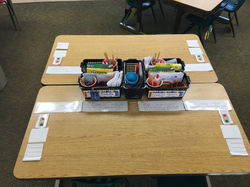 This is the beginning stage of the 'kinder control panels' that I have instituted in my Kinder class to create resources for students to look at before they ask me a question |
 Here is a picture of part of my kindergarten whiteboard in which learning goals are shown visually so students know what they will be learning about as well as some student artwork created during Learning Labs or at home and then given to me. |
 This is an example of collaborative learning within my kindergarten class. Students get to choose different activities focused around literacy or math to work on in groups. I pull these activities out whenever possible! |
 This is a voice level chart that I created and still use to help students regulate their voice levels during instructional times. The level is indicated and students know what each level looks and sounds like. |
 This is a sensory bottle I created in order to help students calm down in they felt overwhelmed or angry. It allows students to focus on something soothing an non-violent to ease their anxiety. |
 These are the original sound cups that I have since revamped to be more instructionally effective and visually appealing, however they still serve their purpose of giving students experience with decoding written words. |
 This is a 'Portable Classroom' that I created in order to teach several first grade students after school in reading and phonics instruction. With the Portable Classroom I was able to give the students an engaging learning experience wherever necessary! |
Reflection
It is important for a teacher to keep in mind that their students have varying preferences when it comes to how much they like to work with others, and how often they like to work independently. It is also important for teachers to understand that in today's world, having collaboration skills as well as being able to take on independent loads are equally valued in the work force and in varying social situations.
Creating and facilitating positive interactions between students is the first step to creating an environment conducive to teamwork within the classroom. Instituting differentiated behavioral management strategies help students to self regulate their emotions and take others into consideration as well. As teacher, giving these resources to the students as well as being a positive model for these strategies is key to creating a classroom in which respectful language becomes the norm.
Along with the facilitation of positive interactions between students, comes the engagement of students with the content and activities being taught. Getting to know your students is a key part of getting them engaged in the lessons being taught, as once you discover their preferred learning styles and interests, you can begin to tailor your instruction to catch and keep their attention and enthusiasm throughout the whole of the lesson.
If students feel that they hold the tools necessary to participate in their own learning and feel safe enough to take risks in the classroom, then they can then begin to let their curiosity and enthusiasm lead their investigations into the world around them. For many students, I have observed a greater struggle in feeling comfortable expressing themselves than reigning themselves in once they feel like they can truly explore themselves and the world around them.
I have been able to use this in my own classroom by differentiating instruction for the interests and learning styles of the various classes I have worked with. I plan to continue getting to know my students' learning preferences and how they prefer to work and explore the world around them. This will influence what activities I implement in my lesson plans and how I design my classroom for the year.
Additional Artifacts
Above are several links to two websites that I have created on the importance of play in learning, as well as the differing methods of classroom management. These illustrate how a teacher can be flexible in the classroom in regards to how the students are learning without sacrificing the order of their classroom (environmentally and behaviorally). The third website is to a web application that allows you to create a blueprint of your classroom setup before you actually begin moving furniture. This will allow to to view (aerially) how the physical setup of the classroom environment either creates, or impedes, the flow or productivity of the room and its inhabitants.