
Standard 6
The teacher understands and uses multiple methods of assessment to engage learners in their own growth, to monitor the learner’s progress, and to guide the teacher’s and learner’s decision making.
This standard focuses on highlighting the multiple types of assessment that exist, and how each type of assessment in used not only to provide students with a grade, but to bring in to focus the students' mastery over a subject along with which in areas of instruction the student needs to gain more experience.
The evidence below shows how I am able to create varying assessments that not only assign a grade to any given assignment but that are specific enough to ensure students succeed, are engaging to complete and are informative for future instruction.
 These are the recorded results for the Thanksgiving unit I planned with my kindergarten class. Highlighted are the students I paid special attention to during assessment as well as a student who showed a great need for intervention |
|---|
 This is a picture of student responses for what they are confused about during a pre-assessment given to my sixth grade class about what media is and how it influences us. |
 This is a picture of student responses for what they are confident about during a pre-assessment given to my sixth grade class about what media is and how it influences us. |
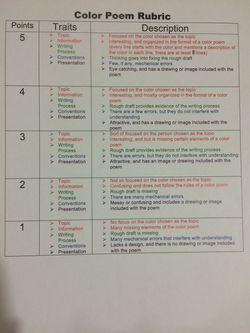 This is a rubric I designed during my time as a student of St. Norbert College in which I created a rubric giving specific expectations for each number grade |
 erfwqa |
 bfgbfzb |
 Assessment never ends with just the grade, we also have to think about what we do after and how we modify our instruction to better suit our students needs |
Reflection
Allowing students to engage in monitoring their own growth and planning how to improve themselves gives students practice thinking meta-cognitively about their own actions and how changing different aspects of a final product can change or increase its efficacy.
An important aspect of assessment for teachers to remember is that their are so many different types of assessment, that there is really no excuse for you to constantly give chapter and unit tests (unless of course, your principal or other state officials mandate it!) There are formative and summative assessments; pre, mid and post assessments, assessments; written, verbal, presentations, you name it!
there are certain assessment that are used more for evaluating progress and informing future pans than for the assessment of a final grade. For teachers as well as students this rings true. Using assessments to intentionally inform future decisions is key to making changes that create better results within a final project or inform better teaching strategies to help your students progress.
I use assessments often in my own classroom, especially formative assessments that allow me to monitor my students progress throughout a lesson or unit. These types of assessments in the form of observations with anecdotal evidence or the collection of data during small activities help me to be able to see how well my students are grasping the content being taught, and tell me whether or not I need to redirect my lessons to address any difficulties or misunderstandings.
Additional Artifacts
Above is a link to an editing and revising checklist I created specifically for a bio-poem that students had to write about a chosen historical figure. The checklists include directions that mandate student engagement in the revisions process, choosing specific lines that can be removed, changed or improved upon to create a more effective poem for their second or final draft. I love have students fill out these kinds of rubrics, because it makes students think more carefully about their own or another student's writing, in comparison to grammar checking and writing 'good job' at the bottom of the page.
The miscue analysis linked above is for the same program mentioned in the previous section (names remain changed for privacy purposes). In this analysis, I analyze student miscues and progress throughout the brief time I was working with these students. This experience provided me with an in depth understanding of not only how helpful running records can be to creating effective lesson plans, but also that being able to take assessed work, gather information from it, discover areas that students need further help with, and design lessons or interventions to help students succeed really makes me feel as if I am making a realistic impact on my students learning!